giffgaff · Senior Product Designer
Apr 2025 - Jan 2026
Nearly doubling activation - and building the eSIM journey that didn't exist
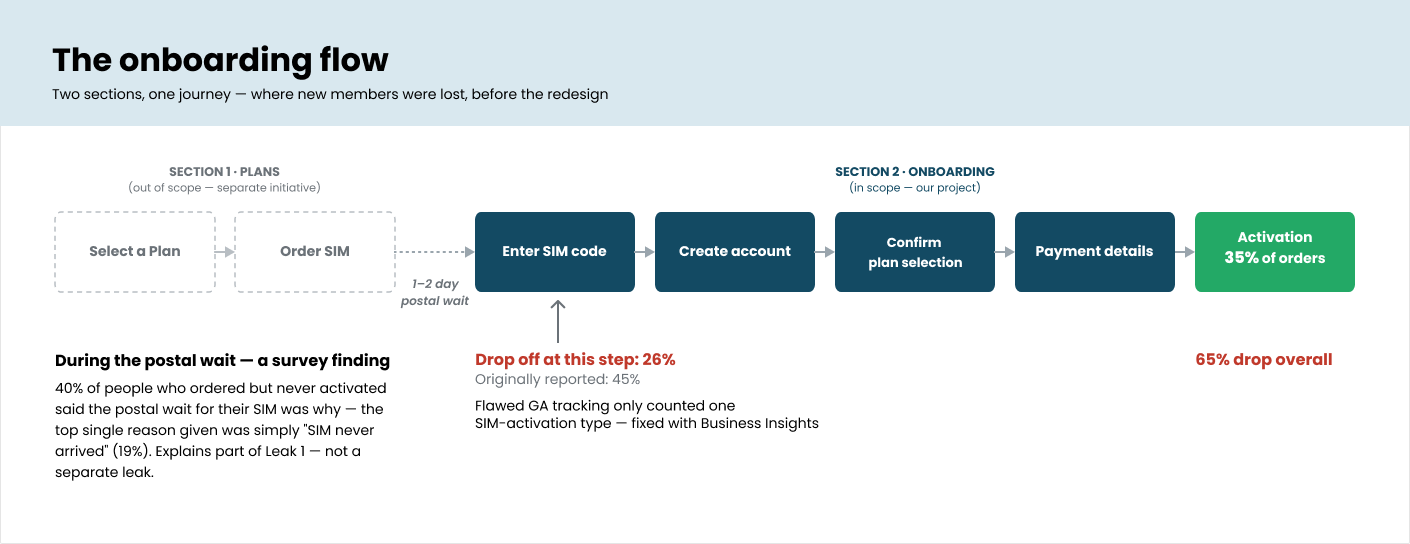
Two-thirds of new members who picked a plan on giffgaff's website and ordered a SIM never went on to activate it. Activation depended on a plastic SIM arriving in the post, and the giffgaff website had no eSIM journey at all.
I was the sole designer on the cross-functional team formed to fix it. We tested the riskier bet first, bringing payment forward, then built the eSIM journey from scratch over three rounds of research.
By handover, activation had risen from 35% to 68% and eSIM had grown from 2% to 13% of all activations, underpinning around £4.8M in annual EBITDA across the two workstreams I led.
My role
I was the sole UX designer for the team and worked for 9 months with:
Project Manager
Content Designer
Front and Backend software engineers
I led multiple stages of the process including:
Journey mapping across flow variations
Problem statement and hypothesis writing
Competitor analysis
Team workshop facilitation
Ideation
High fidelity prototyping
Cross-team collaboration and advocacy
User Research
Stakeholder and leadership presentations
Handover of final designs to engineers
The problem
New members were placing an order, a clear signal of intent, but only 35% of them went on to activate, meaning giffgaff never saw the ongoing payment that came with it. Two things were killing momentum:
A multi-day wait for a physical SIM to arrive in the post. The single most common reason people gave for leaving was simply that it never turned up.
A registration-code step that was leaking people, though a flawed analytics setup had this looking far worse than it actually was: originally reported at 45%, later corrected to 26% once I flagged it as suspect and worked with Business Insights to fix the measurement.
giffgaff was also the outlier among competitors - most others took payment upfront; we didn't.
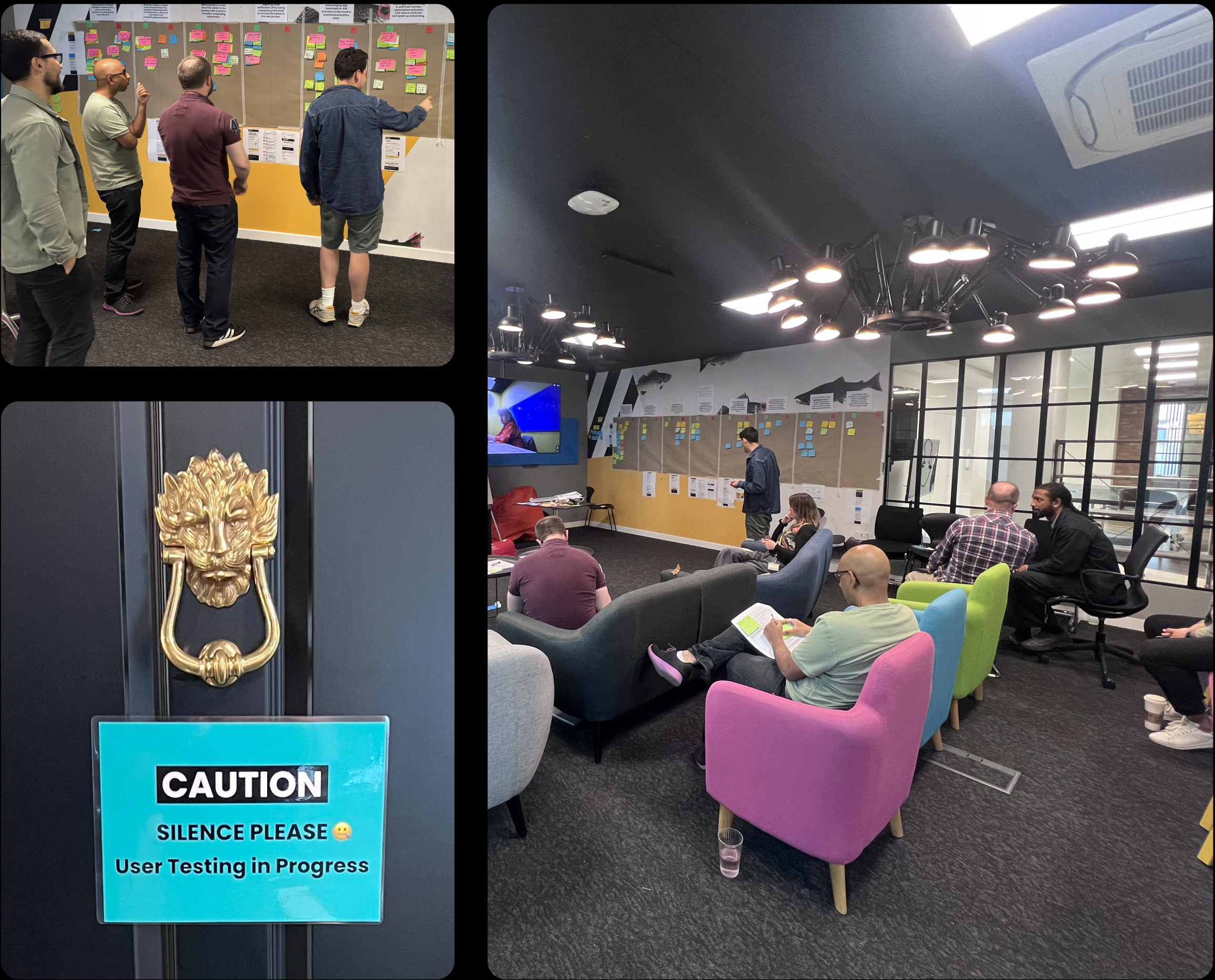
Three rounds of research, each one built on the last
Round one tested eight hypotheses in a day, including the prepaid bet above. Two of them decided the shape of the project.
Paying upfront passed outright: all six participants expected to pay for their plan, especially where the price had been clear from the start. The free SIM was sacred internally and nobody outside the building cared about it.
eSIM failed. Only half chose it when offered a neutral choice, and the reason wasn't scepticism about the technology.
"Never even heard of an eSIM - no idea what that is."
The same participant, forty minutes later:
"Who wants to open post and fiddle around with paper and plastic these days?"
People wanted what eSIM offered once they'd experienced it. What they wouldn't do was pick it cold, off a screen that treated it as one option among two. Experience converted people; a choice screen never did. So the design had to do the persuading.
So I ran an ideation workshop for the whole team, turning the round-one findings into How Might We questions and getting solutions out of the people who would have to build them rather than out of me alone. When that pointed to a second round of testing, I got it designed, recruited and running in four working days. I also built matched iOS and Android prototypes for it, fixing a real limitation of the first round, which had been iOS-only and had therefore told us nothing about half our members.
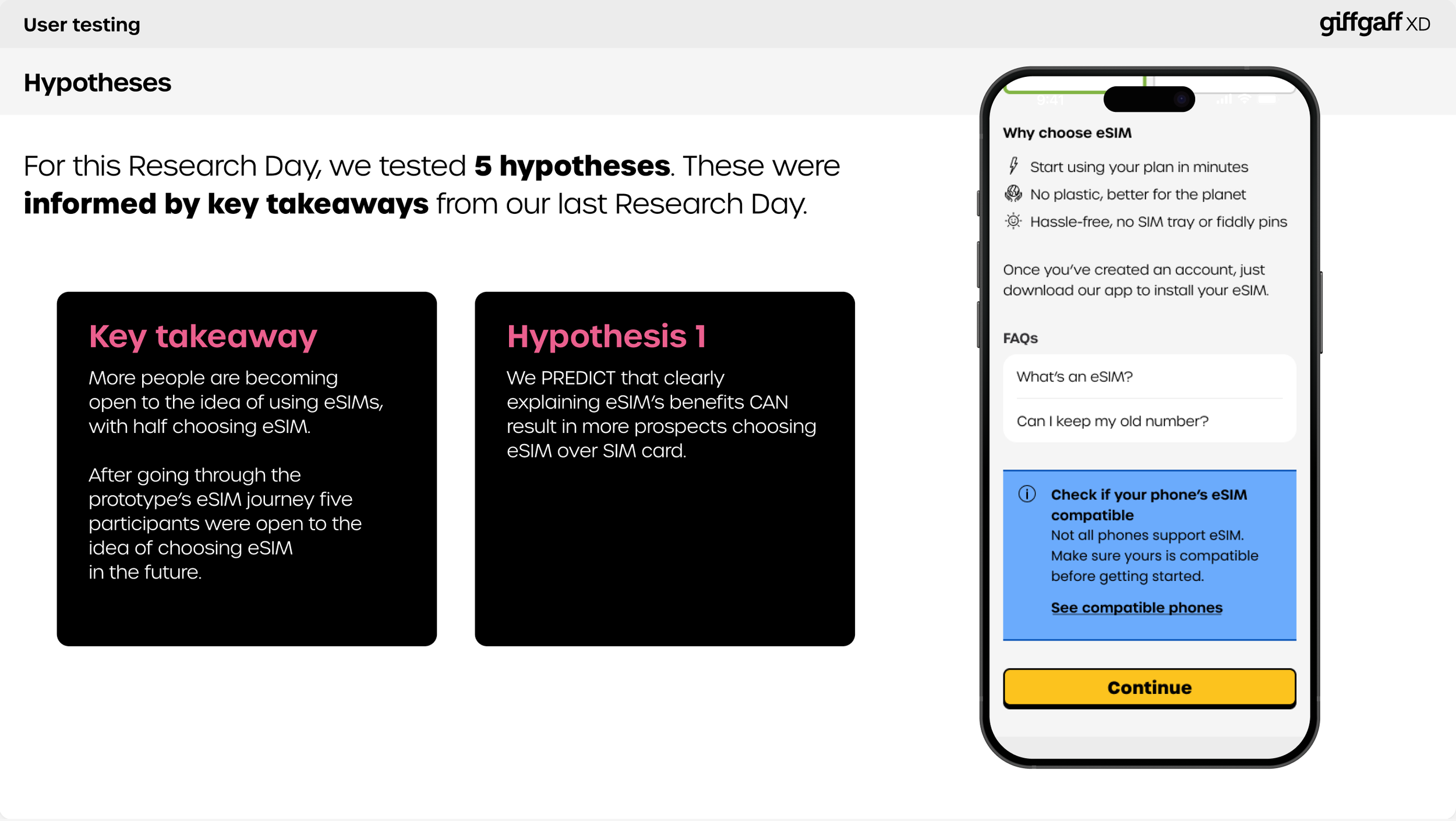
Round two tested fixes for four of the problems round one had surfaced
A confirmation screen after account creation.
In round one, two of six participants tried to create a second account because they weren't sure the first had worked. With a confirmation screen in place, all six knew they had an account.
Porting timings surfaced in the flow.
People didn't know when their number would move across, which stalled them at exactly the wrong moment. Showing the timing in the flow took five of six to a favourable response, and pointed us towards date-specific copy: tell someone their number will be active by Wednesday, rather than leaving them to guess.
Email login.
Four of six had expected to log in with their email address in round one, rather than the member name giffgaff assigns. When we tested it, all six used it without hesitation.
Guidance at the native install step.
Round one had failed this step with all six participants, but had only tested on iOS. Adding guidance and testing both platforms showed Android users coping while every iPhone user still struggled - which told us the problem was specific to iOS rather than general, and that it sat in the operating system rather than in our design.
The presentation that changed the priority
I presented the second round's findings company-wide, to our Head of Product and CEO. The argument I made was that the UK still prefers plastic, but that eSIM is pushing us regardless - US iPhones have shipped without a SIM tray since the 14 - and that if someone sees we offer eSIM and still picks plastic, they remember we offered it. Waiting to react was the risk, not moving early.
The CEO's response was to ask for firm commitments on dates. I took that away and came back with a delivery plan rather than a defence. This was the point the business made eSIM the primary bet.
The design decisions, and what I protected
eSIM pre-selected, labelled "recommended", with a clear way out.
Round one had shown that a neutral choice loses to familiarity, so neutrality was the wrong default. I sold it on instant activation first - "start using your plan in minutes" - with lighter benefits like less plastic waste as support. It reached a 51% take-up rate, and 90% of those who chose it went on to activate.
A compatibility check before commitment, not after.
People were being asked to choose a SIM type before knowing whether their phone could take one.
Porting moved into onboarding
Justified by porters showing 2.4x retention against a port-in rate of 16%, about a third of O2's. With an "I'll do this later" escape hatch, and reassurance copy that came directly out of one participant's fear of pressing something and finding her number hadn't come with her.
A video explainer for the native install step
Written by our content designer and produced by the design team. It helped, and round three showed it wasn't a fix.
Physical SIM parity, protected deliberately.
The brief was to build an eSIM journey. I drafted first versions of both the eSIM and physical-SIM flows together early on, to prove the fundamentals held for both, then iterated on eSIM alone since that was what we were shipping. Most UK members still want plastic. Building eSIM-only would have been the neater project and the worse decision.
Two bets, tested in order
The other bet was commercial rather than experiential: take payment earlier in the order. My PM Jac and I had independently landed on it ourselves, and we tested it first, deliberately, because it was the riskier assumption and because an earlier internal test had already "proven" it a bad idea. We were both sceptical of that result - a test concluding that customers won't pay deserves more scrutiny than one confirming what you hoped. Jac dug into the methodology, found the flaw, and got Business Insights to run it again properly. It worked, though not in the way the hypothesis predicted: fewer people ordered while activations held steady, giving a higher rate off a smaller base. Prepayers turned out to be twice as likely to activate as those who ordered a free SIM.
The hypothesis and its validation in research were mine; the checkout screens already existed and belong to another team, so the change was sequencing rather than new design. It saved around £1M a year, roughly £850k of it in paid media and £180k in SIMs not posted out. The media saving didn't come from design at all - Jac's ongoing conversations with Marketing surfaced that our ad platforms had been counting a SIM order as a conversion whether or not it ever led to an activation.
Early Commit was the smaller bet, and its real value was strategic: it proved the team could move a commercial metric, which is what made the eSIM case fundable.
The finding that wasn't mine to fix
The other consistent theme was logging in. People kept forgetting an assigned "member name" the moment they left the browser for the app store - "it's given me a strange name, I don't know why it needs to give me a name when I've got a name already."
Login wasn't under our team's remit; it belonged to the Identity team. So I asked Jac to invite them to observe the second research day, and they watched six of six participants reach for their email address without hesitation. They shipped it. It's now live for every giffgaff member rather than just new ones, and it was the single most impactful change to come out of the project. Getting it done was a matter of putting the right people in the room, not of designing it myself.
Where I exercised judgment
Not every idea made the cut. Hiding the free-SIM option from the homepage entirely was my own idea. Six lab participants had accepted upfront payment without blinking, so I pushed to remove it. Live, the result was more specific than a simple failure: free-SIM orders dropped, but that drop wasn't recovered by a rise in prepaid orders, so people didn't switch payment method, they most likely just left. We reverted the specific change, though the underlying goal is still being actively pursued through other means. A reminder that people accepting an idea in a research lab isn't the same as the market tolerating it in the wild.
What's still unsolved
One failure mode remained stubborn even in the shipped product: the phone's own native install screens still confused most people, because that part of the journey belongs to the operating system rather than to us.
There's a second one worth naming. Our own metric counts a member as activated before the eSIM is installed on their phone, which means the worst friction in the journey is invisible in the data. Telling the next team that was worth more than the outcome number itself.
The outcome
£4.8M in annual EBITDA across the two workstreams I led - roughly £1M from bringing payment forward, £3.8M from eSIM.
Activation: 35% → 68%
eSIM adoption: 2% → 13% of activations
51% of new members take eSIM now we offer; 90% of those go on to activate
Recognition
Our team won Most Collaborative Team at giffgaff's year-end awards, with four individual team members also recognised. I was nominated for Rookie of the Year, under a year into the business.
From the anonymous award nominations:
“Nigel has been instrumental in making sure we are regularly running insightful user-research days which have given us tremendous insight into what we should be thinking of building next. The positive uplift in meaningful numbers has been significant and impressive.”
Jac Morris
Product Manager