HEAL Security · Lead Product Designer
June 2023 - July 2024
Innovating Cybersecurity in US Healthcare
HEAL Security is a Silicon Valley startup building cybersecurity intelligence for US healthcare. I was its first and only designer, and the company had six months to prove itself: a credible MVP by the end of December to put in front of investors, or close.
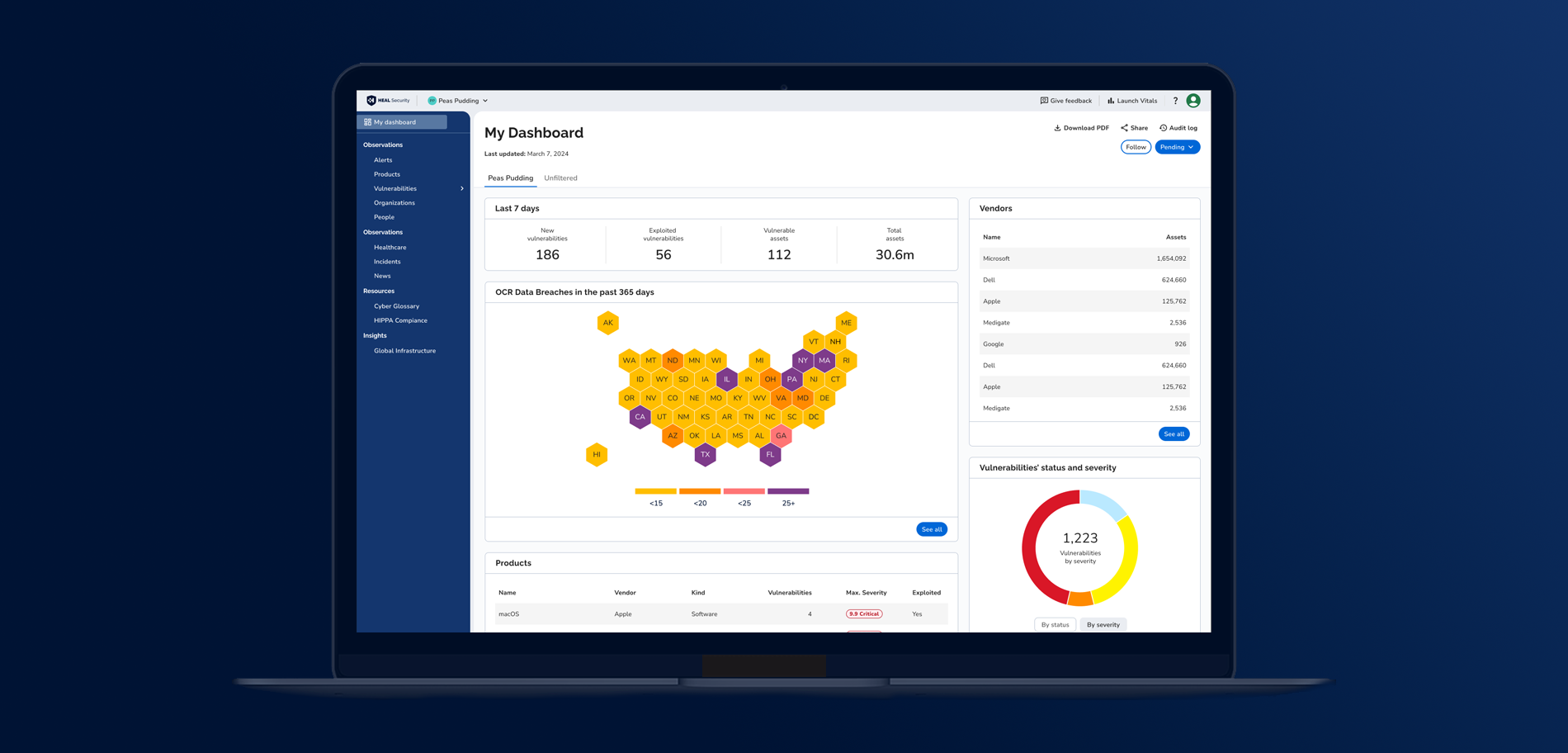
I took the product from a blank page to a launched MVP in that time: the whole interface, from data-dense vulnerability records to a full-screen operations board, and the design system underneath it, matched like for like across Figma and Storybook.
We hit the deadline. The product soft-launched quietly to check it held up in use, and HEAL Security came out of stealth in January 2024 with the platform as its flagship, having raised $4.6M in pre-seed funding led by Health2047, the American Medical Association's venture studio.
My role
I was the sole designer at HEAL Security for most of my 13 months. I joined before we even had a CTO and I worked with the CEO on initial scoping, including Vitals, the first product we shipped. What I owned was the interface: its layout, its interaction and pattern behaviour, and the design system underneath it. In my final month I onboarded and managed my successor.
I worked with:
CEO and Founder
Chief Technology Officer
Project Manager
Business Analyst
Front and back end engineers
For my last two months I also line managed a second designer who joined the team.
As the team grew, scope and product direction were largely set by the CEO and the head of engineering. The interface itself was mine to decide: layout, interaction and pattern behaviour.
The work covered:
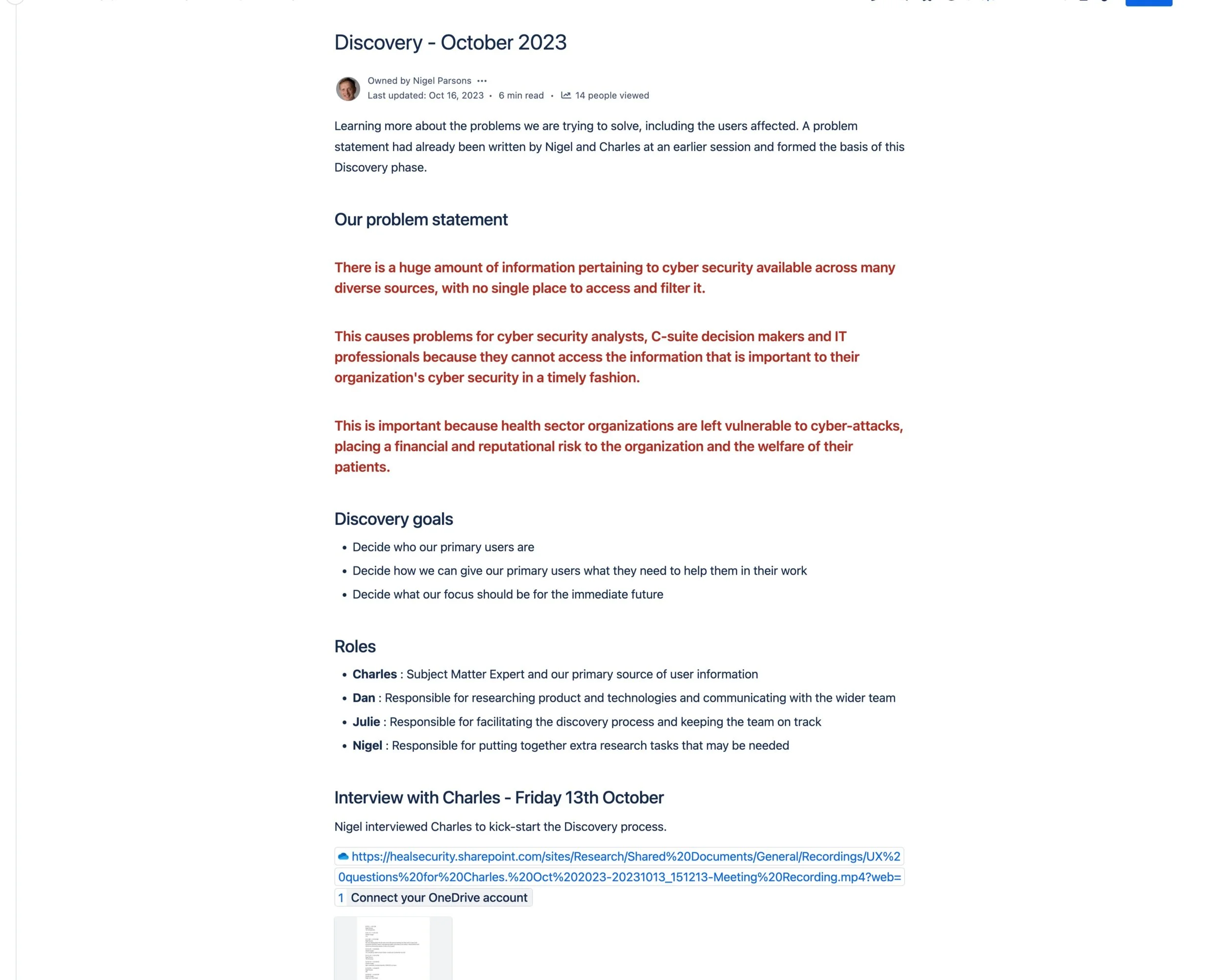
Interviewing the CEO and writing the problem statement;
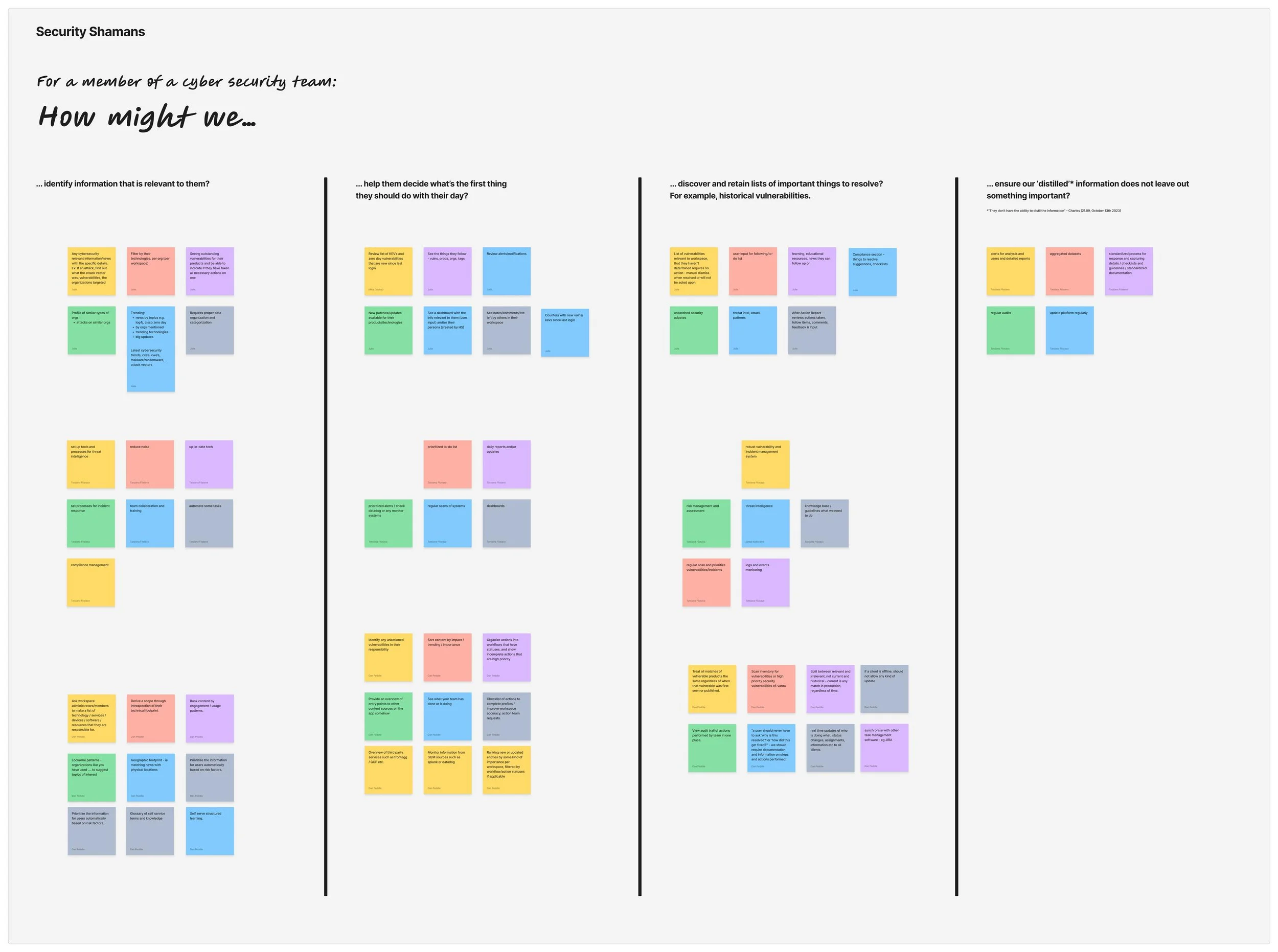
Facilitating discovery and strategic vision workshops
Competitor analysis
Proto-personas built as testable assumptions
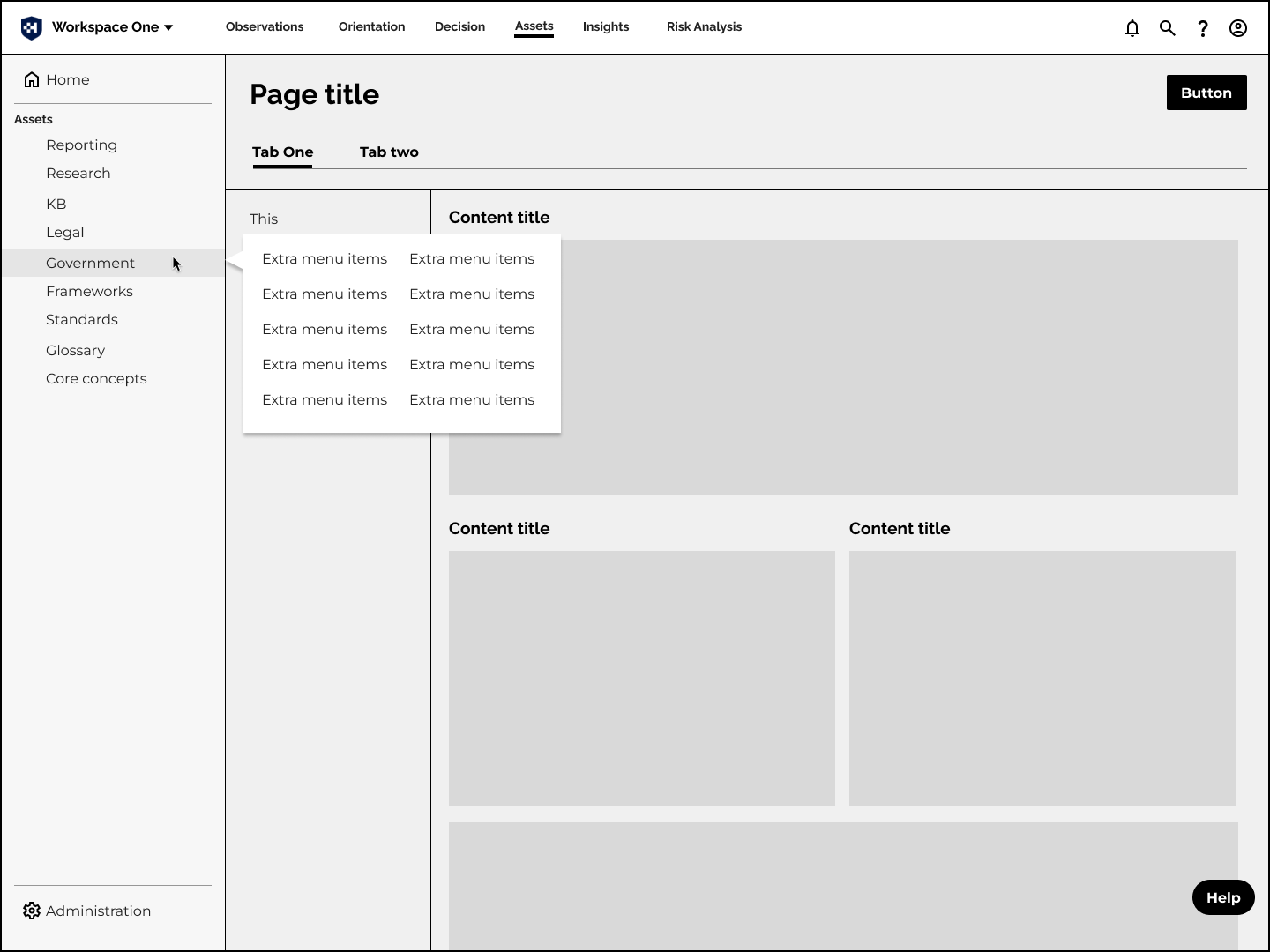
Wireframing and high fidelity prototyping
Design system.
The Challenge
Healthcare providers were once considered off-limits by cyber criminals. That is no longer the case, and the sector now faces sustained targeting that threatens patient data and healthcare infrastructure. HEAL's proposition was to pull fragmented global threat data into one place and make it usable by the people responsible for defending health systems.
The design problem was that nobody on the team could agree on what we were building. The founder had deep domain knowledge and a clear instinct for the product, but it was held in his head rather than written down. I had neither user access nor sector experience. So the first artefact I produced was not a screen, it was a problem statement, written from a long interrogation of the founder and circulated so that everyone was building towards the same thing.
My contributions
Problem statement and workshops
Interviewed the CEO at length to draw out what he knew about the sector he had worked in, then wrote the problem statement myself and used it to run a team-wide “How might we” workshop. It gave the team a shared account of what we were building and became the reference point for scope discussions.
Page templates and dashboards
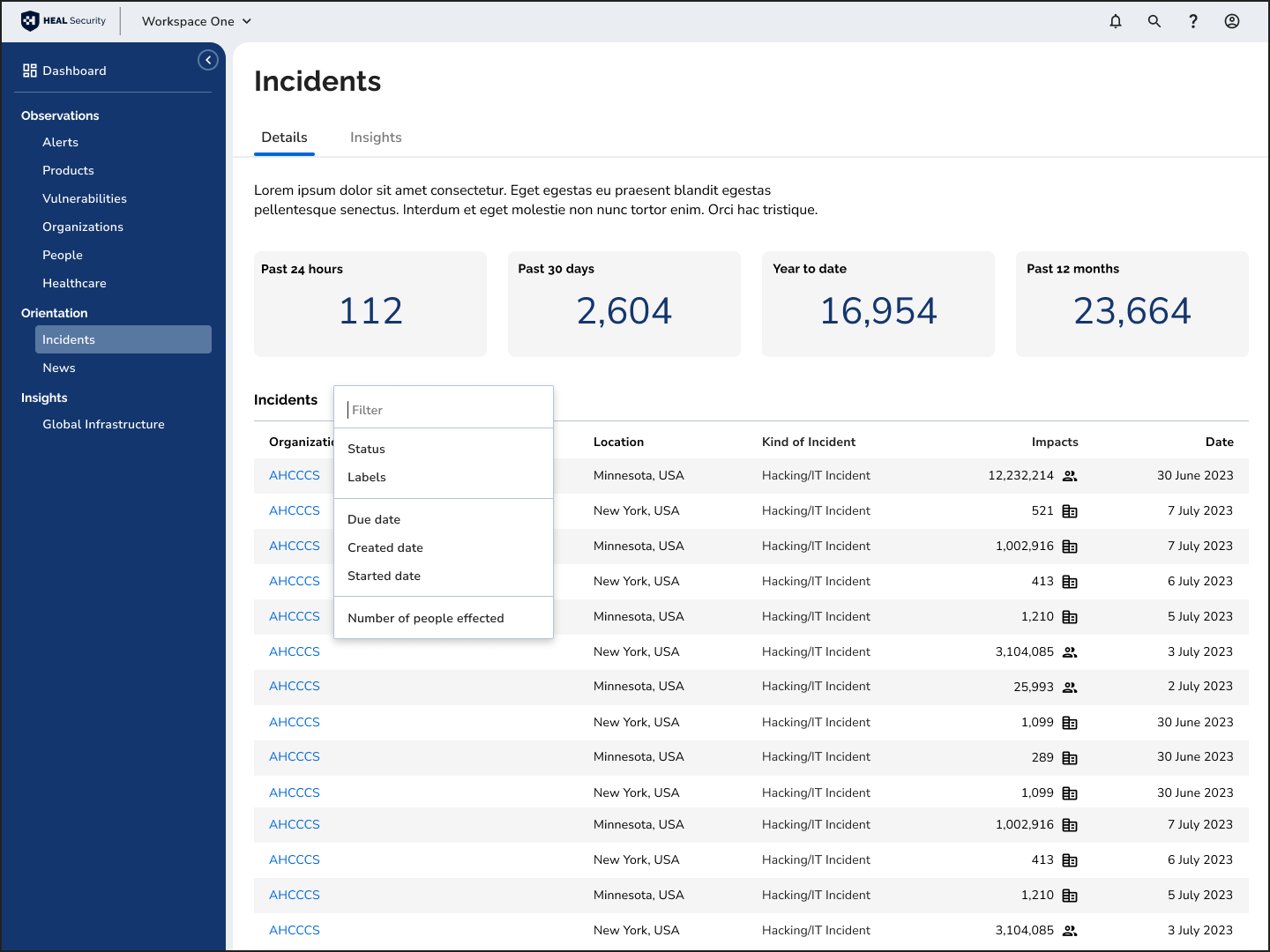
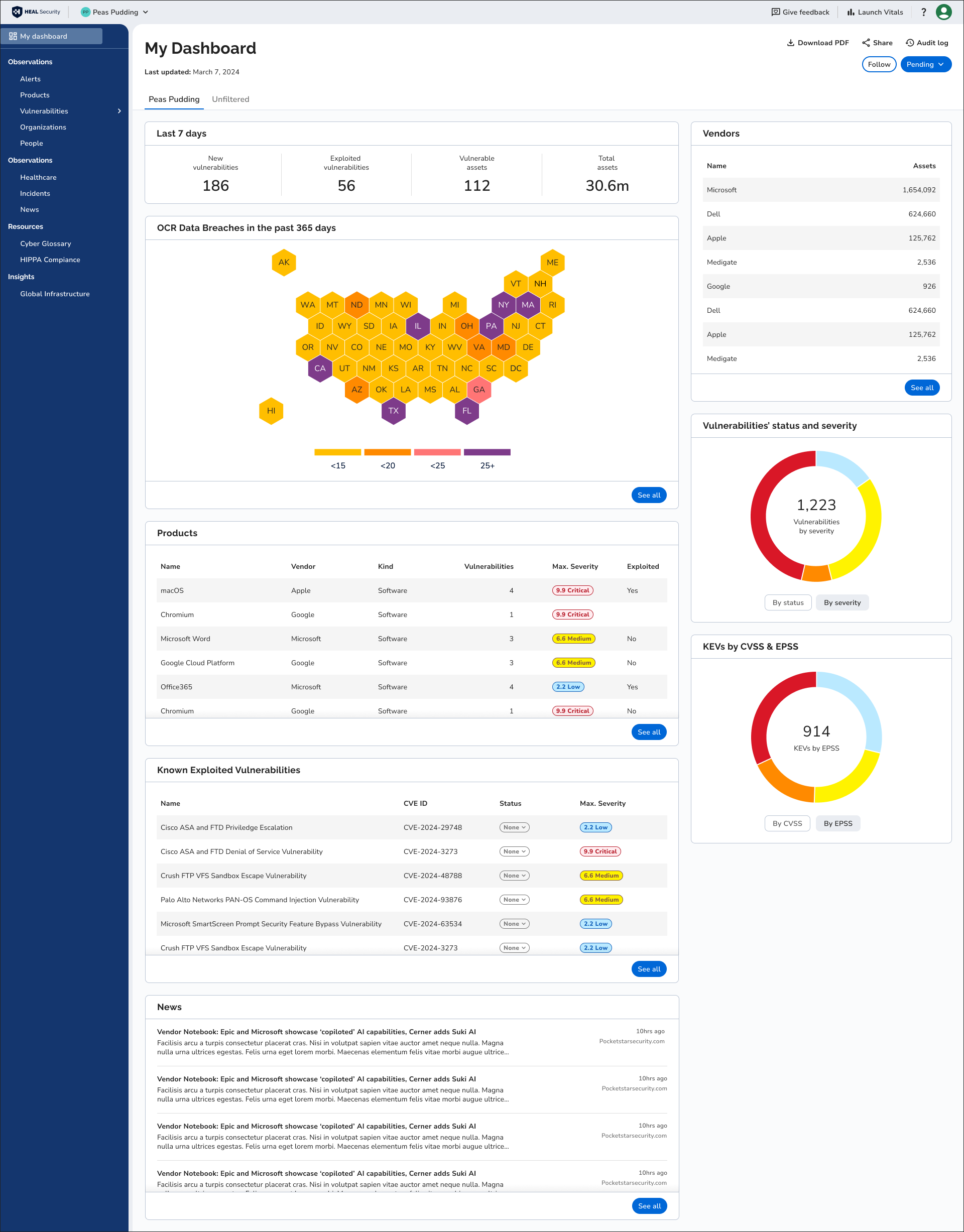
Designed adaptable templates for dashboards, list views and profile pages, so the MVP could present vulnerability, product and provider data in a form each user could work with. Also designed a searchable news section.
Sign-in and upgrade journeys
Designed the end-to-end flows for authentication, workspace roles, trial expiry and upgrade to paid, including the branching logic for admins versus members and for users with an existing paid workspace. Designed and handed to engineering; the paid conversion went live after I left.
Activity timeline
Designed a provenance and change-history pattern for vulnerability records, showing each source addition with its origin, date and link. There was no prior pattern to work from; the approach was mine.
Vitals news board
The CEO's idea, scoped by the two of us together, designed by me. A standalone full-screen board carrying real-time headlines, vulnerability trend charts and US breach data, built to be read at a distance on an office display. My earliest work on the product. Shipped, and given away free as an entry point to the paid Desktop product.


Design system
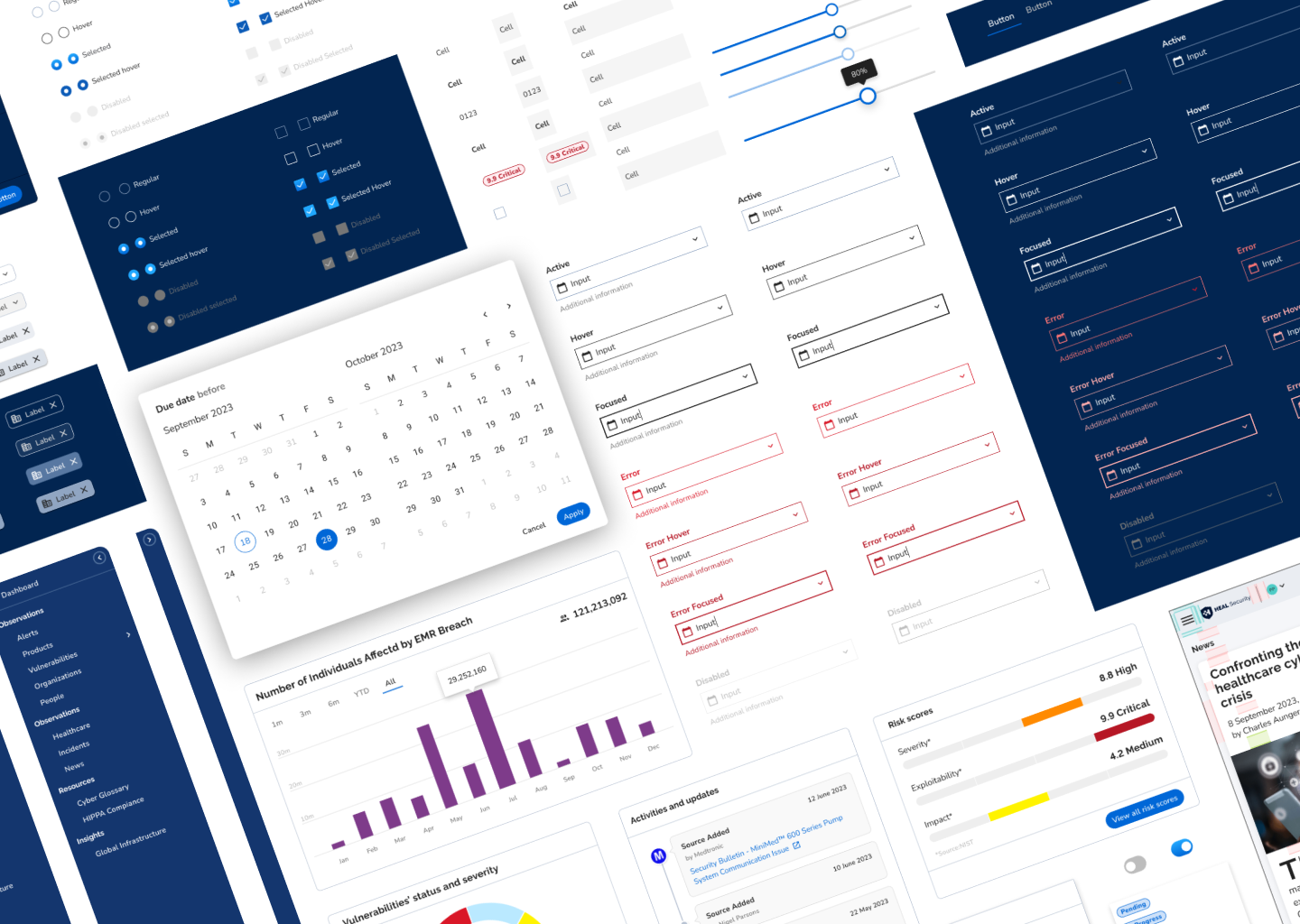
Built the component library in Figma and directed the front end lead to match it like for like in Storybook. Self-initiated, undertaken alongside roadmap work, because establishing consistency early is cheaper than retrofitting it later. Documentation was still outstanding when I left, and a review of the system was the first task I set my successor.
Status workflow
Designed a status workflow to support integration with third-party systems such as Jira. Shipped in the first release.
Follow feature
Designed a Follow feature laying the groundwork for integrations with third-party asset environments. Shipped shortly before I left.
Proto-personas
With no access to real users, I built proto-personas from the founder interviews, a competitor's published persona research and secondary sources on what people in these roles need. I labelled them as proto-personas deliberately: they were hypotheses to be tested against real users once we had them. I also wrote a survey to test them. I left before it was fielded, so those assumptions remain untested.
Brand exploration
A self-initiated redesign of the company identity and website, done because I judged the existing brand was holding the product back. Presented to the CEO and not taken forward.



Positive Outcomes
We hit the deadline. HEAL was pre-seed and running to a hard date: a credible product by the end of December to put in front of investors, with the company's continuation resting on it. We shipped it. I soft-launched quietly first, to check it held up in real use, and HEAL Security came out of stealth in January 2024 with the platform as its flagship, having raised $4.6M in pre-seed funding.
I shipped real complexity, alone. The MVP went out with vulnerability records carrying CVE, FDA and severity data, incident tables, a provenance timeline pattern I designed from scratch, a status workflow supporting third-party integration, and a full-screen operations board built to be read at a distance. I designed all of it as the only designer, in a sector I had never worked in, to a six-month deadline.
My design system was in use, not on a shelf. I built the component library in Figma and directed the front end lead to match it in Storybook, self-initiated and alongside roadmap delivery. He is on record that it brought consistency to the product and made his team's work easier. It was still the reference point when I left, and I set a review of it as my successor's first task.
I line managed for the last two months. A second designer joined the team and I onboarded and managed her directly, handing over the design system, the component libraries and the open questions in person rather than in a document.
Closing reflection
Six months was long enough to build a product and launch it. Thirteen months was not long enough to find out whether the product was right, and that is the honest limit of this case study.
I had no access to users for the whole of it. I worked around that as best I could: proto-personas built from the founder's own domain knowledge and published research, explicitly labelled as assumptions, and a survey written to test them. Neither loop closed before I left, and I would not claim the personas were validated, because they weren't.
What I would do differently is press harder, earlier, for user access, and treat it as a condition of the work rather than something to design around. I built the means to validate it twice over and never got to use either. In a startup running to a funding deadline that is an easy thing to keep deferring, and I deferred it.
What I would do the same is the problem statement. A founder with real domain expertise and no way of transmitting it is a common startup failure, and a written statement everyone could point at was worth more to that team than any screen I produced. The same is true of the design system, which nobody asked for and which the front end lead was still thanking me for months later.
Laurie Loydall
Front End Lead Engineer